Serial and display console

Configuration examples on the internets for configuring GRUB to boot serial console tend to turn off the regular console, for GRUB and for Linux. Here’s how you get serial console and regular keyboard/monitor console for both GRUB and Linux:

# Tell GRUB to use both consoles

echo '#! /bin/sh
echo "
serial --unit=0 --speed=115200 --word=8 --parity=no --stop=0
terminal_input --append serial
terminal_output --append serial
"' > /etc/grub.d/01_serial 
chmod 755 /etc/grub.d/01_serial 

# Tell GRUB to have the kernel use both consoles

grep console=tty /etc/default/grub ||
         echo >> /etc/default/grub 'GRUB_CMDLINE_LINUX="console=tty0 console=ttyS0,115200n8"'

# Make new GRUB config with those settings

grub2-mkconfig > /etc/grub2.cfg  # CentOS
update-grub2

# /dev/ttyS0 serial login – on older systems

systemctl enable serial-getty@ttyS0.service
systemctl start serial-getty@ttyS0.service
Posted in Stuff | Tagged , , , | Leave a comment

Publishing photos of criminal suspects

The SAPS act of 1995 is widely rumoured to grant protection to criminals from being photographed, and from the publication of their likeness. This rumour is based on lawyers lying about the law. Imagine. The horror.

Analysis of South African Police Act 68 of 1995, section 69

Here is the relevant section of the Act, with my commentary. I am not a lawyer, which means I’m just going to tell you what it says, and not lie about it.

Firstly: Police can tell you not to take photos, sometimes

We start with a heading: this is about not having photos taken of some people:

69 Prohibition on making of sketches or taking of photographs of certain persons and publication thereof

And some definitions that say when we mean photograph or publish or take, we mean doing something like that, no matter how you do it

69. (1) For the purposes of this section-
“photograph” includes any picture, visually perceptible image, depiction or any other similar representation of the person concerned;
“publish”, in relation to a photograph, includes to exhibit; show, televise, represent or reproduce; and
“take”, in relation to a photograph, includes the performance of any act which by itself or as part of a process or as one of a sequence of acts renders possible the production of a photograph.

And now, the first group of people you cannot photograph: someone the cops have nabbed, that is going to go to court, but the policeman knows that taking a photo is going to prejudice the case. But it’s not enough for him to just know that there’s going to be a problem: he has to prohibit the taking of the photo. And then you had better listen, or he’s gonna let the criminal go and lock you up instead:

(2) (a) A member who has reason to believe that the taking of a photograph or the making of a sketch of any person who is, in relation to criminal proceedings, detained in custody, will prejudicially affect an ongoing investigation into an offence or alleged offence, may prohibit any person from taking such photograph or making such sketch.
(b) Any person who takes a photograph or makes a sketch in contravention of a prohibition under paragraph (a), shall be guilty of an offence and liable on conviction to a fine or to imprisonment for a period not exceeding 12 months.

Second: There’s a general prohibition on publishing photos of people nabbed by the police

Okay, next: some guy seems to have done something, and he’s been nabbed or he’s run off: for this guy you can take the photo, but you can’t publish it. If he’s hanging around innocently at the scene of the crime as if there’s nothing wrong, then presumably you can publish his photo, with the usual risks for slander if you say something that’s not true:

(3)( a) No person may, without the written permission of the National or Provincial Commissioner, publish a photograph or sketch of a person-
(i) who is suspected of having committed an offence and who is-
(aa) fleeing;
(bb) in custody pending a decision to institute criminal proceedings against him or her; or
( cc) in custody pending the completion of criminal proceedings in which such person is an accused; or
(ii) who is or may reasonably be expected to be a witness in criminal proceedings and who is in custody pending such proceedings.
(b) Any person who publishes a photograph or sketch in contravention of paragraph
(a), shall be guilty of an offence and liable on conviction to a fine or to imprisonment fora period not exceeding 12 months.

The protected classes of people are:

  • (3)(i)(a)(aa) A suspect fleeing: the guy is running away
  • (3)(i)(a)(bb) A suspect in custody: nabbed by the police: this is the guy that is trussed up with the policeman’s boot on his neck, or he’s in the police van, or in the police cells.
  • (3)(i)(a)(cc) A suspect in custody waiting: he’s in jail, and on trial
  • (3)(ii) He’s a witness that’s going to appear in court

The single word “fleeing” might appear to provide broad protection to criminals fleeing the scene of a crime, but its grouping together with the other provisions of the same paragraph indicate that this is someone who is about to be apprehended by the police.

The proper use of this law

While the law does not set out the reasons for its provisions, it appears that the prohibitions on photography have the following goals:

  • Expedience: It is easier to stop prejudicial photography at the crime scene than to deal with the courts later. Criminal lawyers will make vain claims that the photographs contain evidence, and the courts will accept these vacuous claims, provided they use the right magic or masonic words, and criminalising the photograph is easier than instructing judges to judge justly.
  • False witnesses and memory: if a witness sees a photograph of the criminal suspects, it is possible that their testimony about those faces may be based on the photograph and not on their actual observations.

In short: they don’t want you to say “this is the guy”, when the police already caught him.

Woe unto you, lawyers

Now that we have heard the secular law, have a listen to a lawyer’s commentary on the same. You will notice that it’s not quite the same.

SAPS News, Cape Town: Legal specialist in all police matters, Advocate Melville Cloete from the provincial police, recently spoke about the legislation surrounding this topic at a talk at Gene Louw Traffic College in Brackenfell. He addressed members of local neighbourhood watches, warning them of the dangers linked to posting such photos on social media. “You are not allowed to publish a picture identifying an alleged suspect in a crime on WhatsApp or on Facebook before this person had appeared before a court of law,” he stressed. The South African Police Service Act strictly forbids this.

This advocate is not just an avocate. No, he is a specialist. He is a specialist in all police matters. He must have read this law. Strangely, he says things that are not stated by the law. He ignores the provisions of the suspect being in custody or fleeing, and just says “no photos”. Give them a fingernail, and they take the whole car.

The same applies to pictures of anybody who might be a witness in a criminal case.

That’s almost right. But the “might” is deceptive: it is not the possibility of being a witness (5% will do), but the reasonable expectation of being a witness (85% will do). I do not reasonably expect a criminal case to occur at all, much less that witnesses will be called to testify.

And then this gem of doublespeak:

“Members of neighbourhood watches often take pictures of suspects at crime scenes, which you can do, but the moment you send the picture to someone else or post it to a social media platform, it is considered published,” he said. Posting photos could lead to vigilantism.

Actually, police are empowered to prohibit the taking of pictures, and criminally punish those that take the pictures. However, if they fail to do so, that’s their problem. If suspects are at a crime scene, but not fleeing, and not in the custody of the police, then such suspects can be freely photographed and published. The notion that the publisher of a photo is responsible for vigilantism is not found in the police act.

A hefty fine, 12 months imprisonment or a massive civil suit could await you, should you post a picture of any perceived “criminal” on a social media platform.

Could await you. Indeed. Could. But this expert really isn’t explaining anything, but mixing up two unrelated things:

  • Photos prohibited by the police act: sure, the act prohibits photos of people the police are nabbing.
  • Defamation by false statements about an innocent person: if you say something false, well, you deserve whatever you get.

And now, behold, lies:

According to Cloete, the only exception applies when the investigating officer on the scene gives his permission for the picture to be published. In addition to the Police Act, section 35 of the Constitution affords every citizen the right to a fair trial.

The permission of the National or Provincial Commissioner is suddenly not required, because expert lawyer thinks that it’s enough for the investigating officer to say his thing. However, this is not the only exception: the suspect being neither in police custody nor fleeing is the clear exception. The failure of all police to anticipate prejudice at trial and prohibit suspect photographs at a particular crime scene is also an exception.

The learned advocate continues, advocating for making it up as you go:

“The publication of a photo identifying the alleged perpetrator could thus render the trial unfair and it might result in the suspect being acquitted. The same applies if the perpetrator is identified in public before an ID parade has taken place,” said Cloete The publication of such a photo could furthermore defeat the ends of justice, by hampering a pending investigation.

Let’s move away from the police act, and make the public responsible for police operations such as the identity parade (pray tell, how may have happened in the last year, nation wide?) Let’s just wildly accuse them of defeating the ends of justice, because as you know, the ends of justice are served by nobody ever seeing or knowing anything about a crime until a few years hence. Pity the poor judges of the courts, who cannot provide a fair trial in the face of evidence, and who cannot weigh witness testimony where witnesses have seen some of the evidence. It is not the public’s fault if the learned judges of our courts are unable to do a fair trial.

And, our final piece of legal advice:

“It can also lead to vigilante action in cases where the person are responsible.”

Count the weasel words:

  • can also – maybe
  • lead to – some chain of events perhaps
  • in cases where – in a limited
  • are responsible – bad grammar – because you can’t be sure

When there’s that much weasel, you know it’s taking a leap. The government is responsible for vigilante action, because the government is refusing their task.

Tell me how you really feel

This is bad law: these provisions take the government’s task of preserving evidence, and make it everyone’s problem. This is not how law should be done. Law should punish evil workers, and leave everyone else alone. The police have an almost impossible task of convincing the intransigent courts to do justice. The fact that the courts have made up all sorts of reasons to exclude good evidence and testimony should not be the police’s problem, and neither should it be the public’s problem.

This law has aged badly: These provisions were written before the courts shut down all pretence of swift justice in favour of continual postponement. The prospect that the witnesses will be able to identify a criminal after he has aged five to ten years to appear in court is ridiculous. The police should make every effort to speedily preserve evidence and witness statements, because it will be needed when the last witnesses are dead and the case finally comes to trial.

This law is stupid: Digital photography should not be treated as an problem that prevents the proper conclusion of cases, but a source of good evidence. The distribution of the photographs of persons not in custody should be encouraged, so the public can know who the dangerous people in society are.

This law is being abused to say things it does not say: The police advocate’s explanation of the law and his expansion from its actual provisions to a blanket “no photos” policy strongly suggests that the police do not want crime and criminals to be in the public eye: no photographs, no information, no problem.

The advocate’s statement says the police are losing the battle: The advocate concludes with a warning against vigilantism. Think about that: he is so sure that the case will not be finalised, and the result published in any reasonable time frame, that he has to warn the public against doing the job of justice that the government is unwilling to do: to be the revenger to execute wrath upon him that does evil.

Posted in Stuff | Tagged , , , , , , , , , | Leave a comment

Votes for cash: poll tax

Executive summary: People should pay to vote.

Numbering the people

When the people of Israel were numbered, that had to be accompanied by a payment:

When thou takest the sum of the children of Israel after their number, then shall they give every man a ransom for his soul unto the LORD, when thou numberest them; that there be no plague among them, when thou numberest them.
This they shall give, every one that passeth among them that are numbered, half a shekel after the shekel of the sanctuary: (a shekel is twenty gerahs:) an half shekel shall be the offering of the LORD.

Exodus 30:12-13

Every person had to pay half a shekel. Failure to do this would lead to a plague, which is what the “no plague” part is about. And, as it happens, when David neglected the proper manner of numbering the people, a plague indeed did follow:

And Satan stood up against Israel, and provoked David to number Israel.

And God was displeased with this thing; therefore he smote Israel.

So the LORD sent pestilence upon Israel: and there fell of Israel seventy thousand men.

1 Chronicles 21:1, 7, 14

Joab, the commander of the military, who was tasked with doing the numbering for David, found the king’s commandment repulsive (1 Chronicles 21:6 … “the king’s word was abominable to Joab.”) and he knew it was a trespass (1 Chronicles 21:3 … “And Joab answered, … why will he be a cause of trespass to Israel?)

There is not a lot of explanation provided for why a census should be accompanied by payment, but it’s not hard to think of a few reasons:

  • A prelude to war: if you’re about to go to war, you want to know how many people you can expend in the effort. When there’s an emergency, you throw everything you have at it, but numbering when there’s no emergency says you’re planning something bad. If everyone must pay to be part of the war, then you have to face the backlash sooner.
  • A prelude to abuse: Joab found the king’s commandment repulsive (1 Chronicles 21:6 … “the king’s word was abominable to Joab.”) Once you know how many people there are, you may be inclined to tax them, take their stuff in salami slices, etc.
  • A pointless burden: Taking people away from their work to participate in being counted is stupid. It’s stupid to do, it’s stupid to participate in, and it’s stupid to get a result.
  • Quite possibly having someone go throughout every tribe and lay hands on every person is going to spread whatever sickness someone has. Having the priests do the counting is a better idea, because the priests at least know the difference between clean and unclean. Well, they should know.
  • The money matches the people: you can count the money, or the people. You are more likely to get an under-count than an over-count.

It’s a great idea: when you number the people, let each person pay.

Modern voting

Voting is basically the same as numbering the people, except that the people are also sorted into a very few groups according to whatever the vote is for. If people had to pay to be numbered in the past, then it is reasonable that paying to vote could work in the present.

The following problems would be solved by paying to vote:

  • A lot of fraudulent voting will be eliminated: if the price of fraud is actual money, there will be less of it. Want to vote a hundred or a thousand times? That’s going to cost you a hundred or a thousand times. It’s dead easy to change a number in a column, but it’s not as easy to produce a half shekel per vote.
  • The money count must match the vote count. If a region submits more votes than money, then they have too many votes, and they can be disqualified.
  • The money count must match the vote count. If a region submits more money than votes, then they have perverted the votes, and can be disqualified.
  • Self funding: since the voting process produces its own income, the administrators of the vote do not have to have the approval of government, but can do their work without intimidation.
  • Equality: if everyone that votes pays the same amount, then that is a message that all people are equal: the rich do not pay more, neither do the poor pay less.
  • Democracy is the rule of the majority, and the majority are stupid. Forcing the majority to pay for choosing their rulers will eliminate the stupidest part of the voter pool, because they will rather keep the money.
  • Votes for women: women are not stupid, but they have better things to spend their money on than voting. Roll back a hundred years of feminism, just like that. Women should not vote anyhow: I suffer not a suffragette to usurp authority over the man.
  • We pay tribute to receive justice from government as they bear the sword against evil doers, so if we’re electing the government, it makes sense to pay at that point.

Why not do it?

There are a good number of reasons that this is not going to happen in a hurry:

  • A fraudulent voting system keeps the current socialist rubbish going: they are not going towards more accountability, but less: electronic voting has zero accountability.
  • People will do something that costs nothing to get something that is free. If that something costs real money, they will not as easily seek free things from it. The illusion of free stuff is what keeps the voting scam going.

Not paying to vote means that every time we vote, we are struck with a plague of elected “representatives” that we didn’t necessarily elect, who don’t represent us.

Posted in Stuff | Tagged , , , , , | Leave a comment

Find my device or anything that saw it recently and has travelled 15km or so

Google’s “Find My Device” function does a pretty good job of finding a device. It has a few mechanisms:

  • GPS location seen by the device (pretty accurate)
  • Cell tower location (not very accurate at all)
  • Wireless access point locations (quite broad)
  • Quick connections by bluetooth to passing android devices on the “Find my device” network (could be accurate, but is not).

That last method, bluetooth snitching, produces some interesting results.

I dropped my phone by accident, and discovered it missing when I got home. I took the precaution of using the “secure my device option”. The next morning the phone went for an unauthorised walk, presumably because some helpful soul thought he would find the rightful owner as he went about his day.

Find my device reported its location in a number of interesting places:

  • In the actual place where it was found 👍
  • A little way up the road on a nearby highway 👀
  • On the other side of the road from where it was found 👀
  • 1km down the road from where it was found 👀
  • In a suburb 6km away 🤪

All of these locations were reported as 100% accurate – but they were not the location of the phone (except one), but the location of the snitch phone that had recently seen my phone … and then moved. The information about how long it had been since it saw it, and the strength of the signal is discarded.

Here’s the faulty logic:

  • Bluetooth message: “Hi, I’m a lost device: please report my location”.
  • Gallant helper on find-my-device network: “Sure, no problem.”
  • Gallant helper: Oops, don’t have network right now.
  • Gallant helper: Hey, I’ve got network! Let me report my current location.
  • https://www.google.com/android/find/ : Hey, your phone is on the highway in a car zipping around a corner. No wait, it’s in another suburb. No wait, it’s in that shed. No wait, it’s on the other side of the road.

The moral of the story is: don’t issue search warrants without complete technical information. If you suppose that a man is handling stolen goods based on “find my device” then the evidence may actually show that he was merely at some time in the vicinity of stolen goods.

But, just this once, it was found!

Posted in Stuff | Tagged , , , , , | Leave a comment

Hannah’s three bullocks: yes, three.

In the King James Bible, we read this:

And when she had weaned him, she took him up with her, with three bullocks, and one ephah of flour, and a bottle of wine, and brought him unto the house of the LORD in Shiloh: and the child was young. And they slew a bullock, and brought the child to Eli.

1 Samuel 1:24-25

You might wonder why she brought three bullocks, and so do I, but it is consistent with the rest of the Bible, because of the amount of flour she brought, specifically one ephah. Every offering brought to the LORD had to be accompanied by a meat offering of flour mingled with oil. How much in particular?

And when thou preparest a bullock for a burnt offering, or for a sacrifice in performing a vow, or peace offerings unto the LORD:
Then shall he bring with a bullock a meat offering of three tenth deals of flour mingled with half an hin of oil.
And thou shalt bring for a drink offering half an hin of wine, for an offering made by fire, of a sweet savour unto the LORD.

Numbers 15:8-10

Why did she bring wine and flour? Because that is what was required. How much flour did she bring? Three tenth deals? No: there were three bullocks, so she brought nine tenth deals of flour, and the tenth, just to be sure – so a full ephah.

Is it tenth deals of an ephah? Yes. By comparison with the offering for a lamb, these tenth deals are the tenth of an ephah, and not tenths of some other measure:

And a tenth part of an ephah of flour for a meat offering, mingled with the fourth part of an hin of beaten oil.

Numbers 28:5

Pretty straightforward: more joy, more bullocks, more flour, and I guess that’s a big bottle. No, I don’t know why the oil is not mentioned.

Enter the new Bibles

Meanwhile, over in modern Bible land, where the Bible needs to be redone until scholars have the glory due to them, they have puzzled over the slightly unusual grammar of the Hebrew for “three bullocks”, and come up with a “fix” that changes this to a single “three year old bull”

Take it away NIV:

🤮 After he was weaned, she took the boy with her, young as he was, along with a three-year-old bull, an ephah of flour and a skin of wine, and brought him to the house of the Lord at Shiloh. When they had slaughtered the bull, they brought the boy to Eli,

1 Samuel 1:24 NIV 1984 🤮

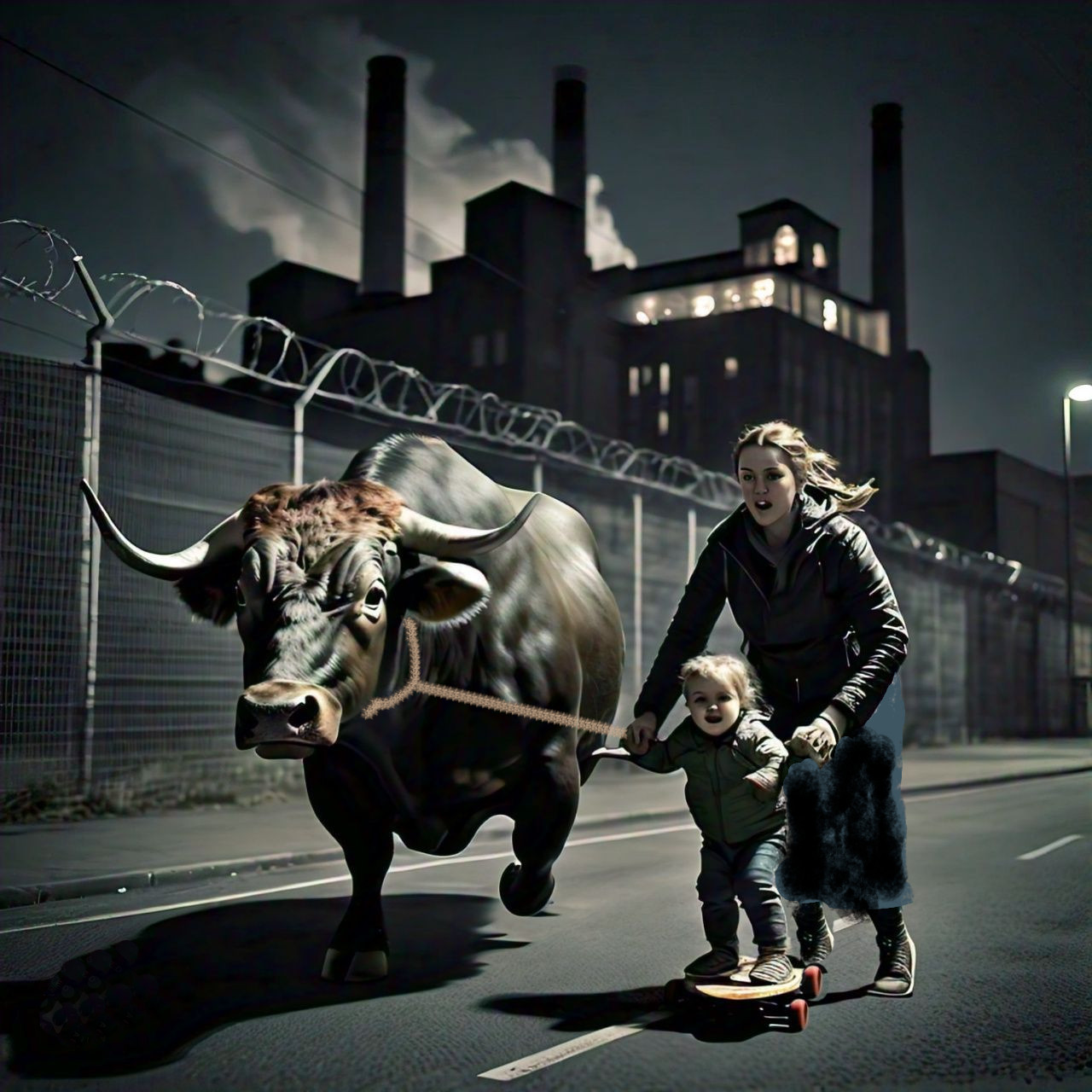
Picture poor Hannah and her weaned son, leading a three year old bull from their home in Ramathaimzophim, of mount Ephraim, over to Shiloh. It doesn’t really matter how far it is: I want to know how long it took to train that bull to follow meekly. This alone would have been the most memorable part of the story.

Meta’s AI thinks that a bull pulling a lady and a toddler would pull a white lady. Well, okay then:

Hannah takes a three year old bull to Shiloh 🤣

Here’s an article discussing the grammar, and taking the side of “three bullocks” for reasons that are probably more clear to Hebrew speakers – Hanna and her sacrifice.

Posted in Stuff | Tagged , , , , | Leave a comment

Lies: Dekra report presented by WeBuyCars does not match condition of car

A tiny note: we bought a car from WeBuyCars. The Dekra report said “Platinum” and “no faults”, and specifically “brakes in working condition”.

We bought this vehicle from webuycars, relying on the DEKRA report that says, in part,

The brake pads and/or discs are in good condition

The car was collected by someone other than a trained mechanic. Turns out, the brake pads were so worn that they were scraping. The brake pads were not in good condition at all: the brake system was running metal-on-metal and making scraping sound on braking, and sounds during regular driving, and loud sounds on reversing.

R1050 later, and new brake pads were in:

Slight scoring on the brake disk from metal-on-metal brake pads

Brake pads have a line that shows how worn the pads are. The line is gone.

Look ma! No lines!
No really, no lines. Shaved to nothing.

In a way, this was not a big deal, except that we were lied to, and what we paid for was not what we received.

We asked WeBuyCars what happened:

Are you able to account for the vast difference between your report, and the actual condition of the brakes on the car? I believe that either the report was prepared without due care by Dekra, or that other brake pads were substituted after the report was made – and of course, there may be some other explanation.

WeBuyCars declined to provide an explanation, neither offered an apology, neither offered compensation, neither considered it to be any kind of problem, because their paper was signed, and they have their money. DEKRA said they are investigating, and didn’t provide any further information. They don’t much care about their name and quality of their work.

WeBuyCars and DEKRA

You can find these people at their web sites.

WeBuyCars: http://www.webuycars.co.za/
DEKRA: http://www.dekra.co.za/

LORD, who shall abide in thy tabernacle?
who shall dwell in thy holy hill?
He that walketh uprightly,
and worketh righteousness,
and speaketh the truth in his heart.
He that backbiteth not with his tongue,
nor doeth evil to his neighbour,
nor taketh up a reproach against his neighbour.
In whose eyes a vile person is contemned;
but he honoureth them that fear the LORD.
He that sweareth to his own hurt, and changeth not.
He that putteth not out his money to usury,
nor taketh reward against the innocent.
He that doeth these things shall never be moved.

If you buy from these people, don’t assume that their claims about the condition of a car are true. If they turn out to be a lie, they will not honour their word, and any loss is your problem.

Posted in Stuff | Tagged , , , , , | Leave a comment

Workaround for Neighbour Discovery failure, for static-configured IPv6 on Linux: Use IPv4 gateway mac for IPv6

Here’s a shell script to figure out what the IP4 gateway MAC address is, and to set that as the IP6 gateway MAC:

#! /bin/bash

# Get the v4 gateway IP address
V4GW=$( ip route get 1 | sed 's/.* via //; s/ .*//; q' )
# Get the MAC address for that
V4MAC=$( ip neigh | grep -F -w "$V4GW" | sed 's/.* lladdr //; s/ .*//'; )
# Get the IPv6 gateway IPv6 address
V6GW=$( ip r g 1:: | sed 's/.* via //; s/ .*//; q' )
# Check if the IPv6 gateway is in IP6-Neighbour-Discovery failure
if ip n | grep -wF "$V6GW" | egrep -q 'INCOMPLETE|FAILED' ; then
 # Get the ip neigh[bour] string, e.g. dev eth0 lladdr 00:01:02:00:ff:ee 
 NEIGHBOUR=$(  ip neigh | grep -wF "$V6GW" | sed 's/  *\(INCOMPLETE\|FAILED\).*//' )
 # delete the failed neighbour discovery
 ip neigh del $NEIGHBOUR
 # delete add a static neighbour
 ip neigh add $NEIGHBOUR lladdr $V4MAC
fi

This was necessary for a machine where the gateway decided that responding to neighbour solicit requests was optional. (Still don’t know why it felt like that.)

Posted in Stuff | Tagged , , , , , , | Leave a comment

Code snippet: This service allows sftp connections only: Create a scp-only user for ssh

This user bob can only run scp, and not get a shell by ssh. Every other ssh-y thing he tries should get the error “This service allows sftp connections only.”

bob=bob                       # or bob=marysue
echo >> /etc/ssh/sshd_config <<EOF
Match Group sftponly
  ChrootDirectory %h
  ForceCommand internal-sftp -u 0002 -d /incoming
EOF

 sudo -u $bob sh -c 'mkdir ~/incoming'  # here's a place for your stuff, bob
 groupadd sftponly                      # group for scp and sftp only
 usermod -a -G sftponly $bob            # bob: you're in it
 chown root /home/$bob                  # sorry bob, we're going to chroot here, so you can't have it

This is reasonably secure™, but it doesn’t stop him from logging in at the console … or with telnet, or with su if he gets some other code running. If you don’t have telnet enabled, you can enable it now for this particular security hole. Actually, the shell should be changed to something listed in /etc/shells that is not a shell, but that is an exercise to the reader.

Posted in Stuff | Tagged , , , | Leave a comment

Vengeance

We should obey laws without question, right?

When the question comes up as to what should be done about unjust government and unjust law, and abuses of authority, invariably some kind soul will point us to the 13th chapter of Paul’s letter to the Romans, which says:

Let every soul be subject unto the higher powers. For there is no power but of God: the powers that be are ordained of God. Whosoever therefore resisteth the power, resisteth the ordinance of God: and they that resist shall receive to themselves damnation.

Romans 13:1-2 (KJV, of course)

This is then interpreted to mean that …

  • We should carefully follow all laws and every regulation made by government and their agents, officials, agencies and brokers (these being the “higher powers”, you see – higher than us, and therefore the subject of this verse.)
  • That if we disobey a law, fail to fulfil a regulation, or so much as squeak a word of objection against some odious provision, God himself will destroy us (that’s the “damnation”, you see)

This is hogwash. Hogwash is what you get when you wash a pig: the water washes over a pig, and this teaching to obey the government in all things is what comes off.

Let’s take a step back, and read the context: this is not a free-standing discussion of the topic of bad government, but it is a part of a larger discussion of something different.

Personal vengeance must defer to government vengeance

The fuller context of this quote is a discussion of personal vengeance: taking revenge for some wrong — sorting things out for yourself, by striking at your adversary, either as an individual, or as a group. This context is not completely obvious, because the chapter break is in the middle of the topic:

Here’s the full passage, with the bits referring to vengeance highlighted:

17 Recompense to no man evil for evil. Provide things honest in the sight of all men.
18 If it be possible, as much as lieth in you, live peaceably with all men.
19 Dearly beloved, avenge not yourselves, but rather give place unto wrath: for it is written, Vengeance is mine; I will repay, saith the Lord.
20 Therefore if thine enemy hunger, feed him; if he thirst, give him drink: for in so doing thou shalt heap coals of fire on his head.
21 Be not overcome of evil, but overcome evil with good.
13:1 Let every soul be subject unto the higher powers. For there is no power but of God: the powers that be are ordained of God.
2 Whosoever therefore resisteth the power, resisteth the ordinance of God: and they that resist shall receive to themselves damnation.
3 For rulers are not a terror to good works, but to the evil. Wilt thou then not be afraid of the power? do that which is good, and thou shalt have praise of the same:
4 For he is the minister of God to thee for good. But if thou do that which is evil, be afraid; for he beareth not the sword in vain: for he is the minister of God, a revenger to execute wrath upon him that doeth evil.
5 Wherefore ye must needs be subject, not only for wrath, but also for conscience sake.
6 For for this cause pay ye tribute also: for they are God’s ministers, attending continually upon this very thing.

Romans 12:17-13:6

This is a lesson about living as a Christian, and not being wise in your own conceits (your own dumb ideas that don’t relate to the real world). Verse by verse it says:

  • 12:17 Don’t lash out at someone that wrongs you
  • 12:19 Don’t take revenge against someone that wrongs you
  • 12:19 Taking vengeance is not for us, but for the Lord
  • 13:3 It is not you, but rulers that must terrorise evildoers
  • 13:4 The task of rulers is to take revenge for God, and execute wrath on evildoers
  • 13:6 The task of rulers is funded by taxes, and it is their only job (taking revenge on evildoers)

So what about Romans 13:1?

  • “Let every soul be subject unto the higher powers.” That means that we must leave off our own wrath and vengeance in subjection to the properly appointed powers that should handle wrath and vengeance: the rulers, who are God’s agents. God is the highest power, and he has delegated his power for vengeance to rulers.
  • “For there is no power but of God:” This means that no man can get into a position where he is to execute wrath and vengeance on evildoers apart from the will of God.
  • “the powers that be are ordained of God.” This means that you can observe what powers currently exist to dispense wrath and vengeance, and know that these are the properly appointed powers that God has put in place. He has chosen the existence of rulers for this purpose.

This passage then tells us that if a Christian is inclined to take revenge, he should rather rely on human rulers (the higher powers) to lawfully protect him by taking revenge on his behalf. This means that unjust vengeance is not permitted to Christians, such as Lamech’s violence against a young man that hurt him. This means that even when we have just cause for vengeance, the execution of this vengeance falls upon the power that God has ordained: rulers that are a terror to evildoers. As Christians, we expect and require from our rulers that they take vengeance against evildoers on our behalf.

What government should do

Some examples of how rulers should be a terror to workers of evil:

  • If someone has committed unlawful mischief against me, a ruler must execute wrath upon the evildoer, covering his back with stripes corresponding with the severity of his misdeed. The evildoer is in terror of the pain that he will suffer.
  • If my goods have been stolen, the ruler must return them to me at the thief’s expense, with some compensation. The evildoer is in terror of losing his ill gotten gains, and even his hard-won work.
  • If a capital crime has been committed – a murder, a kidnapping, a rape, adultery, or some abomination has been done – the rulers must execute wrath on the doer of the evil, taking away his life from the face of the earth. The evildoer is in terror of death and hell, and every evildoer that considers doing likewise is in the same terror.

Much as the rulers are obligated to God to do the work for which they are appointed, they are not obligated to me. I am not in a position to command them: they are not my servants, but the servants of God (his ministers), and they attend to the punishment of evildoers according to God’s ordinance, not mine. I plead for justice, but God requires them to do justice. I have full confidence that they will do their work as ordained by God. If they will not, then they can expect to deal with God that appointed them. If they will not, then that’s also the modern day.

What of evil rulers?

It is common cause that in modern times that rulers have no interest in the task that God has ordained them to do. They absolutely refuse to be a terror to evildoers Instead it is common to find rulers that protect evildoers, while terrorising good works. Lately they also terrorise all that reprove evil. This is a great evil: they are ordained to restrain wickedness by God, but they instead let wickedness run freely, and boldly promote wrongdoing. They hold the position, but they refuse to do the work.

In addition, modern rulers energetically punish any person that will do the work of justice instead of them, for “taking the law into his own hands” — because that is a great evil: taking the task of being a terror to the evil out of the hands of the lazy slobs that refuse to do it. They are actually correct that people should not do this — this is the message of Romans 12 to 13 — but they are wrong when they suppose that they are innocent while they fail to do their work. They neither do justice, and they prevent those that would do justice.

Each member of the ruling party, each judge, and each police and prisons offer should consider that he is occupying a position that God has ordained for the terror of evildoers, and that he will be held to account for his performance of this task. Currently the task is being done so poorly that this accounting must necessarily be unpleasant for every single person involved. Almost every single person in these seats is unqualified to do the job, and if qualified, then the job is being done without fidelity. If there are exceptions, good for them.

Punishment replaced by prevention and regulation

In South Africa, we supposedly have the following systems for punishing evildoers:

  • The police: supposedly they catch evildoers, and deliver them to the courts. Actually, they catch only regular citizens, and the lowest class of criminal. Sober criminals can do as they please for a long time. And that’s before we consider corruption.
  • The courts: supposedly they will decide on the appropriate punishment for evildoers, but in practice, they simply don’t. Rich evildoers can game the system almost indefinitely. Some that do actual crimes are actually selected for punishment after an insanely long time, but this does not help at all. Those that commit petty crimes are not flogged or made to pay restitution, but instead are subject to the most cruel and degrading form of punishment imaginable:
  • The prisons: supposedly they will rehabilitate evildoers, but actually they provide lifetime protection for those that have done capital crimes (murderers, sodomites, rapists, kidnappers), and then allow those evil doers to commit unspeakable evils on all that pass through their doors.
  • Parliament: supposedly they make laws that will restrain the hand of evil in our country. They do no such thing: instead they decree unjust laws and endless regulations about how free men should behave: a licence for every single that does not require a licence, and the freedom for every low official to shape his own law to his liking.

The modern trend in law is not that the law sets a punishment for an evil, but rather that the law sets out a list of regulations about how things should be done, by which they hope to provide an environment in which evil works don’t happen. Generally these regulations provide means for the confiscation of all of the goods of a good citizen and the destruction of his livelihood, but do not at all deter the criminal class from their misdeeds.

  • Instead of punishing murders, regulations limit the distribution of useful weapons. The result is that only people with nothing to lose commit murders.
  • Instead of punishing killers in automobiles, there is a dizzying set of regulations for road safety, and violators of these regulations are punished, without anyone actually being harmed.
  • Instead of thieves being punished, citizens are made to pay insurance to have some semblance of security in their posessions.
  • Instead of the punishment of evildoers, they have prisons for the supposed “rehabilitation” of evildoers: no wrath is executed, but the evildoer is temporarily put in confinement with the very worst that humanity can produce in order to teach him the error of his ways. The result is that people with nothing to lose learn more and more dangerous and evil ways.

Vengeance on wicked government

The old testament bears ample witness that God raises up men to punish evil rulers, and nations to punish errant nations. He sets up kings and removes them, and he uproots nations for their wickedness. If a nation under an evil ruler seeks his face, he will often deliver them from the evil rulers, by providing them a saviour: and the saviour generally goes about and slays the evil rulers as his first official act.

Moses led the people of Israel out of Egypt, and Pharoah perished with his army and his nation was destroyed. Ehud slew Eglon king of Moab, and set the people free from the wicked law that they were under. Jehu killed Ahab’s family, and friends, and all the prophets of Baal. The wicked nation of Israel was carried away by the Assyrians. The wicked nation of Judah was carried away by the king of Babylon, and he executed justice on the wicked king Zechariah:

So they took the king, and brought him up to the king of Babylon to Riblah; and they gave judgment upon him. And they slew the sons of Zedekiah before his eyes, and put out the eyes of Zedekiah, and bound him with fetters of brass, and carried him to Babylon.

2 Kings 25:6-7

Just as God has ordained rulers to do wrath on those that do evil, if those rulers do evil, and make wicked laws, God will ordain someone to do wrath on them. They may hold themselves innocent, but they are not. They may claim that they have the mandate of heaven, but they do not. They may claim that wrath on them is against law, against regulations, against coventants, against constitutions, against treaties — and it may be — but it will be too late, and the new ruler will make new laws.

So what do we do?

Doing justice is not our problem. This is the government’s problem. We get to cry to God for justice, and he will not make us wait long. We are not about to suffer wrath and vengeance. God is going to bring justice to his own when they ask him.

As we are here at the end of the world, we are faced with judges and rulers that have no fear of God, and no regard for man. We are routinely deprived of our right, and we can even be punished for seeking justice from rulers. We should always pray and not faint, as Jesus told in a parable:

1 And he spake a parable unto them to this end, that men ought always to pray, and not to faint;
2 Saying, There was in a city a judge, which feared not God, neither regarded man:
3 And there was a widow in that city; and she came unto him, saying, Avenge me of mine adversary.
4 And he would not for a while: but afterward he said within himself, Though I fear not God, nor regard man;
5 Yet because this widow troubleth me, I will avenge her, lest by her continual coming she weary me.
6 And the Lord said, Hear what the unjust judge saith.
7 And shall not God avenge his own elect, which cry day and night unto him, though he bear long with them?
8 I tell you that he will avenge them speedily. Nevertheless when the Son of man cometh, shall he find faith on the earth?

Luke 18:1-8

We should not dwell on the oppression of regular people by wicked rulers, nor on the gifts that are given to wicked rulers by which they pervert the task to which they are ordained:

Surely oppression maketh a wise man mad; and a gift destroyeth the heart.

Ecclesiastes 7:7

God will bring them to justice. It will be swift. It will be final. It will likely be bloody. It will be just.

governments.

The righteous shall rejoice when he seeth the vengeance: he shall wash his feet in the blood of the wicked.

Psalm 58:10
Posted in Stuff | Tagged , , , , , | Leave a comment

Job Seeker Exemption Certificate 2023-10

If you are an unemployed job seeker, consider offering this guarantee to prospective employers, that says that you will not take them to law for giving you a job:

Job Seeker Exemption Certificate 2023-10

I, the undersigned, by this signed letter, undertake to personally pay to the named employer all penalties and payments and awards and cost of obligations imposed on the employer for a breach of labour rules related specifically to my employment, plus 20 percent of that amount. I acknowledge that the law affords me certain rights with respect of my employment, and that the employer can be financially penalised for giving me work, and this undertaking is to compensate the employer so that he suffers no loss should legal steps be taken. This undertaking applies only to matters related to the first six months of my employment with this employer.

In simple language: I want to work, but if things go wrong, and if they force you to pay money to them or to me, I will pay that same money back to you, plus 20 percent. I request that I be paid weekly, rather than monthly, since this undertaking exposes me to personal financial risk.

Signed:

Date:

Place:

Employer name:

Witness 1:

Witness 2:

South African labour law has made it difficult for job seekers to get work, since the employer has no legal protection against expensive claims from inexperienced and unsuitable new workers. Most employment arrangements are unproblematic, but there are problems, the employer and an unsuitable employee should be able part ways without the intervention of the state, and the losses should be limited. This should especially be the case for the first few months of employment.

If an employer dismisses an employee while this agreement is in operation, the CCMA and labour court may force the employer to pay (say) ten thousand Rands to the employee. That will cause this undertaking to become effective, and the employee will pay twelve thousand Rands to the employer. If the employer is forced to re-employ the unsuitable worker, the cost of the employer’s obligations are the entire cost to company for that worker for the duration of his employment, and the worker agrees to pay that to the employer, plus twenty percent.

We are free men. Free men don’t need law that is stupid.

Posted in Stuff | Tagged , , , , | Leave a comment